Venturi Air Valves for Critical Laboratory Airflow Control: What You Need to Know

Walk into any well-designed research lab, and you’ll notice the environment feels controlled. Temperature stays steady. There’s no strange smell drifting between rooms. Fume hoods pull air consistently. That kind of stability doesn’t happen by accident. It comes from a ventilation system that’s doing its job accurately, every hour of the day.
Most of the attention in lab design goes toward equipment, benches, and safety protocols. The airflow system sits behind the walls, largely invisible, but it’s carrying a lot of responsibility. When it works well, nobody notices. When it doesn’t, the problems show up fast, in the form of pressure imbalances, contamination risks, or fume hoods that aren’t performing the way they should.
That’s the conversation that keeps bringing facility engineers and lab designers back to Venturi Air Valves.
Why Lab Airflow Is a Completely Different Challenge
Most people who work in commercial HVAC understand the basics of air distribution. Office buildings, retail spaces, hotels: these environments need comfortable temperatures and reasonable air quality, but they’re fairly forgiving. If airflow drifts a little, the worst outcome is usually a complaint about the temperature.
Labs don’t work that way. The airflow requirements in a research lab can shift within seconds. A researcher opens a fume hood sash. A centrifuge starts running. Occupancy in one room drops while another fills up. Each of these events affects the ventilation balance, and the system needs to respond before that imbalance causes a problem.
In labs that handle hazardous chemicals, biological materials, or pharmaceutical compounds, the margin for error is narrow. Airflow that’s off by even a modest amount can allow contaminants to escape containment zones, disrupt room pressure relationships, or affect the accuracy of sensitive experiments. This is why the standard VAV damper approach that works fine in an office building simply isn’t the right tool for a critical lab environment.
How a Venturi Air Valve Actually Works
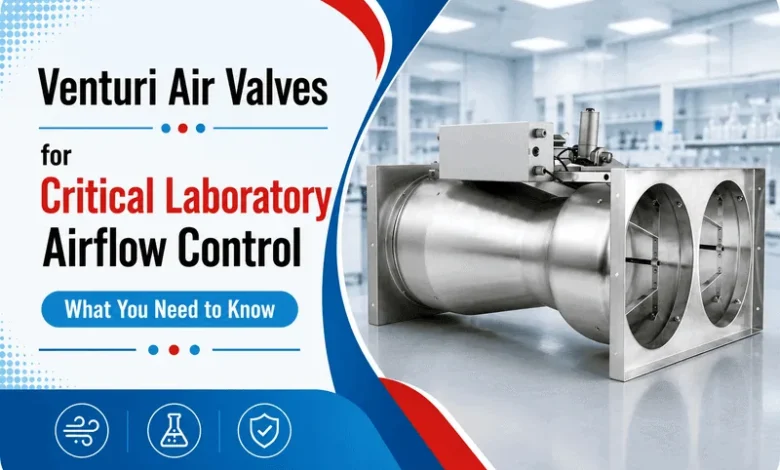
The core design of a Venturi Air Valve is straightforward, and that’s part of why it works so well. Inside the valve body, there’s a narrow, hourglass-shaped section. A spring-loaded cone sits within that section and moves continuously in response to changes in duct pressure.
When pressure rises in the duct, the cone shifts to reduce the opening. When pressure drops, it opens up. This mechanical correction happens on its own, without waiting for a sensor reading, a BMS signal, or a controller decision. The valve is, in the truest sense, pressure-independent.
Compare that to a conventional VAV box. A standard damper-based system has to measure airflow, send that data to the controller, wait for a response, and then move the damper. In a normal building, that delay doesn’t matter much. In a lab where a researcher just yanked open a fume hood sash, that delay is the difference between the exhaust system catching contaminants and not catching them.
Venturi Air Valves correct themselves in under 100 milliseconds. That’s the kind of response time that actually matches how labs get used.
Room Pressure Control You Can Actually Count On
Maintaining the right pressure relationship between rooms is one of the trickiest parts of lab ventilation. Some spaces need to operate under negative pressure so nothing escapes. Others require positive pressure to keep contaminants out. In many facilities, both types of spaces exist side by side, and the pressure boundaries between them have to hold consistently throughout the day.
This gets complicated in larger buildings. When one lab opens a fume hood, the pressure shift can ripple through connected ductwork and affect other zones. If the airflow control equipment reacts slowly, pressure relationships drift. That drift creates real risk in spaces where cross-contamination between areas isn’t acceptable.
Because Venturi valves respond mechanically and immediately, they hold their setpoints across a wide range of duct pressures, typically 0.3 to 3 inches w.g., without active correction from the building management system. The BMS still handles scheduling, setpoint changes, and broader system coordination. But the real-time pressure response happens at the valve level, which is exactly where it needs to happen.
Where Venturi Valves Deliver the Most Value
Not every building needs this level of airflow precision. But there are facility types where the case for Venturi Air Valves is clear.
Research and university labs deal with constantly changing ventilation demands. Different experiments, different chemicals, and different occupancy levels throughout the day mean the airflow system has to be genuinely responsive, not just good on average.
Pharmaceutical manufacturing environments have strict requirements around cleanroom pressure cascades. Maintaining the right differential between Grade A zones and containment areas isn’t a guideline; it’s a regulatory requirement. Airflow equipment that drifts or lags under pressure changes creates compliance exposure.
Biosafety labs working with infectious or hazardous biological materials depend on accurate room pressurization to keep materials where they belong. The consequences of a pressure failure in a BSL-2 or BSL-3 environment are serious, and the ventilation system doesn’t get a second chance.
Hospital and clinical labs operate under uptime requirements that don’t leave room for equipment that needs frequent attention. The mechanical simplicity of a Venturi valve, one moving part, no electronics required for basic pressure response, aligns well with those expectations.
Energy Efficiency Is a Real Part of the Conversation
Lab buildings use a lot of energy. It’s common for a mid-sized research facility to consume five to ten times more energy per square foot than a typical office building, and the ventilation system is usually the biggest driver of that figure.
Part of the reason airflow control matters for energy efficiency is that a system which tracks its setpoints accurately can actually reduce flow when appropriate, during unoccupied periods, at night, or when fume hoods are closed, without drifting up above minimums when it’s not supposed to. A system that hunts around its setpoint, never quite settling, wastes energy constantly and quietly.
Venturi Air Valves hold minimum setpoints accurately during unoccupied periods. That means supply and exhaust fans can run at genuinely reduced speeds rather than compensating for valve drift. Across a building with dozens of fume hoods and lab spaces, that effect adds up to meaningful savings over a full year of operation.
Long-Term Reliability Without the Maintenance Headache
Facility engineers pay attention to what happens after installation, not just at commissioning. Equipment that needs frequent calibration, sensor replacement, or controls tuning adds cost and disruption over time. In labs where ventilation system downtime is difficult to schedule, that’s a real concern.
Venturi Air Valves have one moving part. There’s no firmware to update, no sensor to recalibrate, and no actuator to replace for basic pressure response operation. In clean supply air applications, a service life of 10 to 15 years without significant maintenance is common. In corrosive exhaust duty, the life depends on material selection, but the mechanical simplicity still holds an advantage over systems with more components.
The EB Air Control Venturi Air Valve is available in 6, 8, 10, and 12-inch sizes and integrates with building management systems through MODBUS or BACnet using the Belimo NMQ24A-VST actuator and VRU Universal Modular Controller. It operates in both CAV and VAV modes, covers a pressure range of 0.3 to 3 inches w.g., and holds airflow within approximately plus or minus 5 percent.
Choosing the Right Airflow Control for Your Facility
If your facility handles materials or processes where stable airflow isn’t just a comfort issue, Venturi Air Valves are worth evaluating seriously. The combination of fast mechanical response, true pressure independence, and low maintenance demand makes them a practical choice for labs that need reliable performance day after day.
For facilities working through the selection process, the EB Air Control Venturi Air Valve product page includes full specifications, brochure downloads, and sizing information to help match the right valve to your duct conditions and pressure requirements.